

Joint Efforts for Mangrove Conservation with LasTree
Enabling access to mangrove research data for the sustainable management of Indonesia’s coastal ecosystems
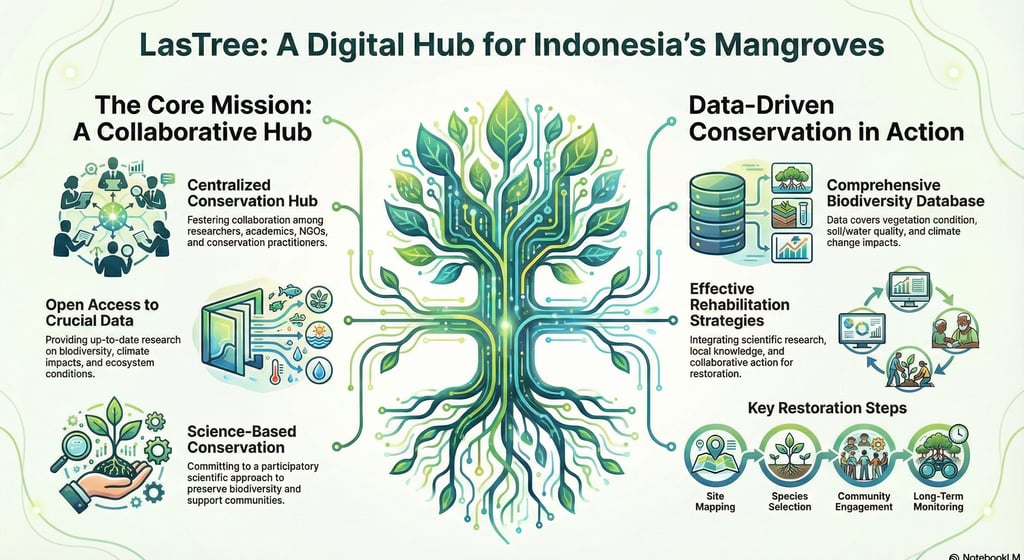
LasTree.io is a digital platform dedicated to mangrove ecosystem research and conservation in Indonesia.As a research-driven startup, we provide open access to up-to-date data and research findings on mangroves, establishing a collaborative hub for researchers, academics, and conservation practitioners. Our platform offers a comprehensive database encompassing biodiversity records, ecosystem conditions, climate change impacts, and mangrove rehabilitation strategies across various regions in Indonesia.
Through a participatory scientific approach, LasTree.io is committed to supporting the sustainable development of coastal communities while preserving the rich biodiversity of mangrove ecosystems. We invite collaboration from international researchers, academic institutions, NGOs, and donors who share a concern for the future of Indonesia’s coastal ecosystems to join us in this science-based conservation mission.
About LasTree.io
Scientific Services for Mangrove Ecosystems
Collaborate through access to the latest mangrove ecosystem research and data from Indonesia
Mangrove Biodiversity Database


Comprehensive data on mangrove biodiversity and ecosystem conditions across Indonesia.


Mangrove Rehabilitation Strategies
A scientific approach to mangrove rehabilitation and climate change impact mitigation.
A centralized platform fostering collaboration among researchers and practitioners for the conservation of mangrove ecosystems.
Mangrove Conservation Hub
A Geospatial Analysis Approach using NDVI and NDMI Differencing
Focus: Strategic planning for sustainable mangrove eco-tourism
Method: Geospatial analysis using NDVI & NDMI differencing over time
What it measures:
NDVI → vegetation health/greenness
NDMI → moisture/hydrological condition
Key value: Detects change trends to flag priority areas (improving vs degrading zones)
Outcome: Supports zoning, conservation actions, and tourism management to balance development and ecosystem protection
LasTree Project
Theme: Joint efforts for mangrove conservation with LasTree
LasTree’s role: Enables easier access to mangrove research data (integrated, shareable, user-friendly)
End goal: Support evidence-based, sustainable management of Indonesia’s coastal ecosystems
Conservation Project
LasTree is committed to supporting various mangrove conservation projects across Indonesia through collaboration with researchers, NGOs, local governments, and community groups. Each project is designed to preserve mangrove ecosystems, strengthen coastal resilience, and enhance the well-being of surrounding communities.


Mangrove Ecosystem Data
LasTree provides open access to comprehensive mangrove ecosystem data covering key aspects such as biodiversity, vegetation condition, soil and water quality, and the impacts of climate change in coastal areas. The data are sourced from scientific research, field surveys, and ongoing monitoring by various stakeholders.
Each dataset is designed to support scientific analysis, conservation planning, and data-driven decision-making by researchers, policymakers, and environmental practitioners. Through an integrated approach, LasTree aims to enhance understanding of mangrove ecosystem functions and their role in maintaining environmental balance and supporting coastal communities.


Rehabilitation Strategies
LasTree highlights effective rehabilitation strategies for degraded mangrove ecosystems by integrating scientific research, local knowledge, and collaborative action. The main strategies include site assessment and mapping, selection of appropriate mangrove species, community engagement, and ongoing monitoring to ensure long-term ecosystem recovery.
Restoration initiatives are supported by data-driven planning and adaptive management, enabling practitioners to address site-specific challenges such as soil salinity, hydrological changes, and human disturbances. Educational programs and capacity-building activities are also conducted to empower local communities in maintaining and protecting rehabilitated areas.
